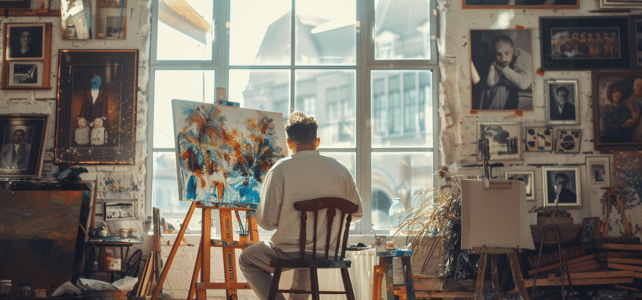
Some artistic dynasties have marked history through the generations. Family heritage often plays a fundamental role in the transmission of talents and opportunities. The example of painters like the Brueghel family or sculptors like the Bernini shows how skills and knowledge are passed down from parent to child, thus creating prolific artistic lineages. Beyond technical skills, the family environment can provide a valuable network of contacts and an intimate understanding of the art market. These advantages give artists from recognized families increased visibility and legitimacy, facilitating their rise in the artistic community.
Artistic Dynasties: Transmission of Talent and Fame
Some families, through successive generations, have managed to perpetuate and enhance their artistic heritage. Take the Matisse family: Henri Matisse, master of the Fauves, saw his talent and fame spread through his descendants. His son, Pierre Matisse, distinguished himself as an art dealer in New York, while his granddaughter, Jacqueline Matisse-Monnier, and his great-grandsons, Jean-Matthieu and Georges Matisse, continue to keep this heritage alive through institutions like Maison Matisse and SP Les Héritiers Matisse.Mark Rothko, who passed away in 1970, passed on to his daughter, Kate Rothko, not only an artistic legacy but also a legal burden. Kate fought to preserve the integrity of her father’s work against the abuses of art dealers. This struggle shows how artistic succession can be both an honor and a challenge. The Wildenstein dynasty, a family of art dealers, also illustrates this transmission of talent and fame. Daniel Wildenstein, who died in 2001, left his sons, Alec and Guy Wildenstein, an artistic empire. However, the succession was not without turmoil, marked by family conflicts and legal battles.
- Henri Matisse – master of the Fauves
- Pierre Matisse – art dealer
- Jacqueline Matisse-Monnier – granddaughter of Henri Matisse
- Jean-Matthieu Matisse – founder of Maison Matisse
- Georges Matisse – head of SP Les Héritiers Matisse
The transmission of artistic heritage is not limited to family. Consider the case of Vivian Maier, an amateur photographer who passed away in 2009. Her works were rediscovered and valued by collectors and art historians, ensuring her posthumous fame.Baxter Neal Helson, although known for different reasons, shows how family notoriety can influence perceptions and opportunities in the artistic world. Artistic fame, shaped by family heritage, is undeniably a determining factor in the career and recognition of artists.
The Challenges and Opportunities of Family Heritage in the Art World
The transmission of artistic heritage within families poses complex challenges. Loretta Würtenberger, director of the Institute of Artist Estates, and Karl von Trott, a lawyer, emphasize that the stakes are both legal and artistic. Heirs often have to navigate between preserving the integrity of the work and commercial imperatives. Take the case of Claude Dumont Beghi, lawyer for Sylvia Roth Wildenstein, widow of Daniel Wildenstein. The conflicts surrounding the succession of Daniel Wildenstein show how tricky the management of inheritance rights can be. The widow, Sylvia, and Alec Wildenstein’s second wife, Liouba, had to face prolonged legal battles to secure their share of the inheritance.
- Loretta Würtenberger – Director of the Institute of Artist Estates
- Karl von Trott – Lawyer and co-author
- Claude Dumont Beghi – Lawyer for Sylvia Roth Wildenstein
- Sylvia Roth Wildenstein – Widow of Daniel Wildenstein
- Liouba Wildenstein – Second wife of Alec Wildenstein
Opportunities are also abundant. Jean-Matthieu Matisse, founder of Maison Matisse, and Georges Matisse, head of SP Les Héritiers Matisse, have transformed the legacy of their great-grandfather, Henri Matisse, into thriving institutions. These examples show that informed and strategic management of family heritage can offer new artistic and economic perspectives.