
Rolling tobacco remains the most sought-after product by French smokers crossing the Italian border. In 2026, the price gap with France remains structural, despite the tax increases initiated by Rome. The sales format, distribution network, and customs rules deserve special attention for anyone considering a purchase during a stay or border crossing.
30 g format in tabaccheria: the Italian specificity of rolling tobacco
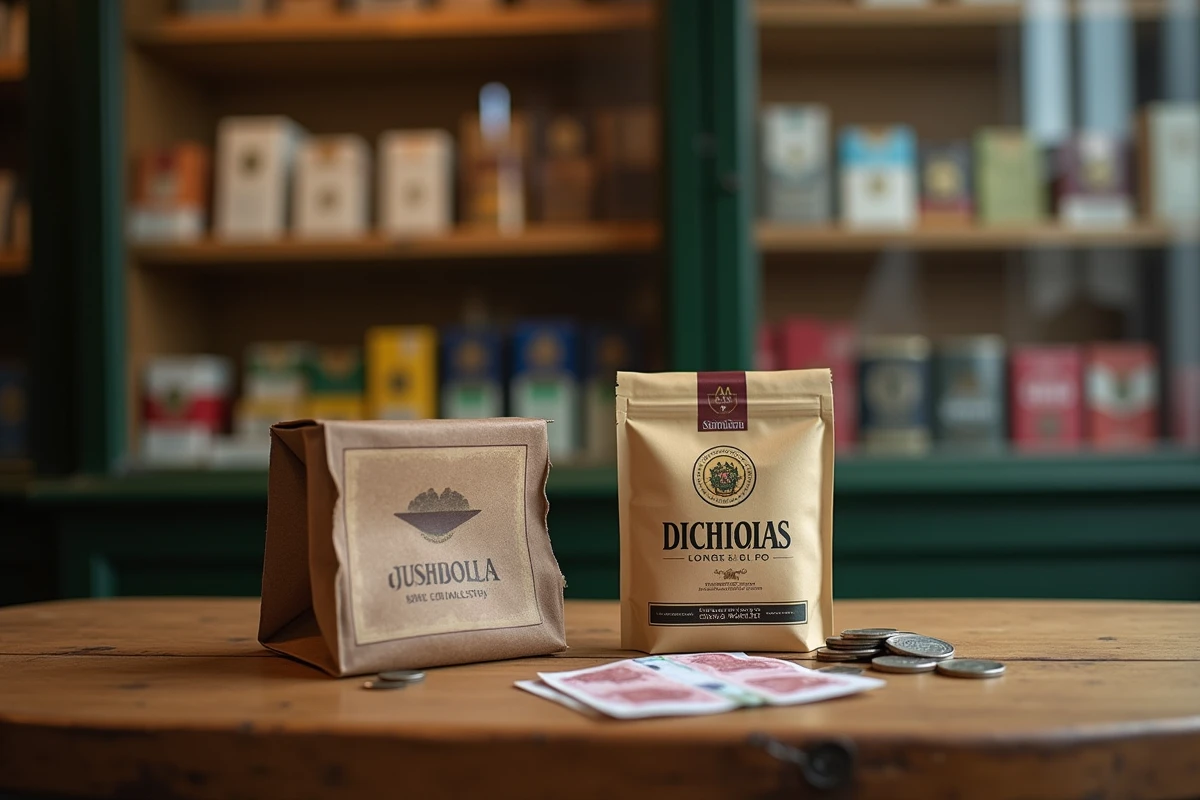
Most online comparisons focus on the price of a standard pack of cigarettes. Rolling tobacco follows a different logic, starting with the packaging. In Italy, the dominant format is the 30 g pouch, whereas the French market mainly offers 40 g or 50 g pouches.
This difference in weight skews quick comparisons. An Italian pouch priced lower does not contain the same amount of tobacco. To assess the real cost, one must think in grams, which few travelers take the time to do in-store.
The sales channel is also unique. In Italy, tobacco is almost exclusively purchased in tabaccheria, these tobacco shops recognizable by their black “T” sign on a white or blue background. Supermarkets and gas stations sometimes offer a few references, but the selection is much more limited. To find a decent choice of brands and formats in rolling tobacco, the tabaccheria remains the essential stop.
Those who wish to compare the price of rolling tobacco in Italy 2026 with French rates will therefore need to convert the price to grams, taking into account this 30 g format which complicates the direct reading of labels.
Price gap rolling tobacco France-Italy: what explains it in 2026
In France, pouches of rolling tobacco have prices that have fluctuated, since early 2025, within a high range. The most common brands are priced above 14 euros for a pouch. In Italy, several sources aimed at travelers indicate that rolling tobacco costs almost half as much as in France, even after recent increases.
The explanation primarily lies in taxation. France has been implementing a continuous tax increase program on tobacco for several years, as part of the National Tobacco Control Program 2023-2027, with the stated goal of creating the first tobacco-free generation by 2032. Italy has also initiated increases, with a tax hike schedule planned until 2028, but the starting level was significantly lower.
Rolling tobacco remains structurally less taxed than industrial cigarettes in Italy, which maintains a marked price differential between the two products. Smokers who roll their cigarettes thus enjoy a relatively clearer advantage than buyers of standard packs.
Why Italian increases do not close the gap
The Italian government has planned gradual increases in tobacco taxation. The first measures took effect at the beginning of 2026. However, the pace of these increases remains moderate compared to French increases, which regularly add several dozen cents per pack each year.
The price gap between the two countries is only slowly narrowing, and it would take several years of Italian increases without corresponding increases in France to achieve alignment. The available data does not allow us to say whether Italy will ever reach price parity with France on rolling tobacco.
Buying rolling tobacco in Italy: customs rules and legal limits
Buying tobacco in Italy is legal for any adult European resident. The question concerns the quantities allowed when returning to France. European regulations set indicative thresholds for travel between EU member states:
- For rolling tobacco, the customs allowance is set at 250 g per person for personal use
- For cigarettes, the indicative threshold is 200 units, or one carton
- Beyond these quantities, French customs may require proof that the tobacco is intended strictly for personal use and not for resale
These thresholds are not absolute ceilings within the intra-European framework, but indicators. A traveler carrying more is subject to a more thorough inspection and must be able to justify personal use. The burden of proof then rests on the traveler.
Border areas: controls and actual practices
Smokers from border departments (Savoie, Haute-Savoie, Alpes-Maritimes) are well acquainted with the journey to Italian tabaccheria. French customs regularly conduct checks on return routes, particularly on the Mont-Blanc tunnel highway and the coastal road between Ventimiglia and Menton.
Seizures most often involve quantities clearly intended for resale: several kilos of tobacco, documented repeated purchases, or transport on behalf of third parties. A one-time purchase within the 250 g limit does not pose practical difficulties.

Rolling tobacco in Italy: what online comparisons often overlook
The majority of articles comparing tobacco prices between France and Italy focus on packs of industrial cigarettes. Rolling tobacco is treated as a secondary subject, even though it represents a significant share of consumption in France.
Several points deserve attention before planning a purchase:
- The brands available in Italy are not all the same as in France. Some popular references among French rollers may be absent from Italian tabaccheria
- The 30 g packaging means that more pouches must be purchased to reach the same quantity as a single French 50 g pouch
- Prices displayed vary little from one tabaccheria to another, as the price is regulated by the Italian state monopoly
- Cash payment remains very common in small tobacco shops, although credit cards are becoming more widespread
The savings made are real for a regular smoker, but they must be weighed against the cost of travel. For a border resident, the calculation is quickly made. For a passing tourist, buying rolling tobacco constitutes a supplementary saving, rarely a reason for travel in itself.
The price differential between France and Italy on rolling tobacco remains, in 2026, among the most pronounced in Western Europe. The upward trend on the Italian side does not fundamentally alter this reality in the short term.