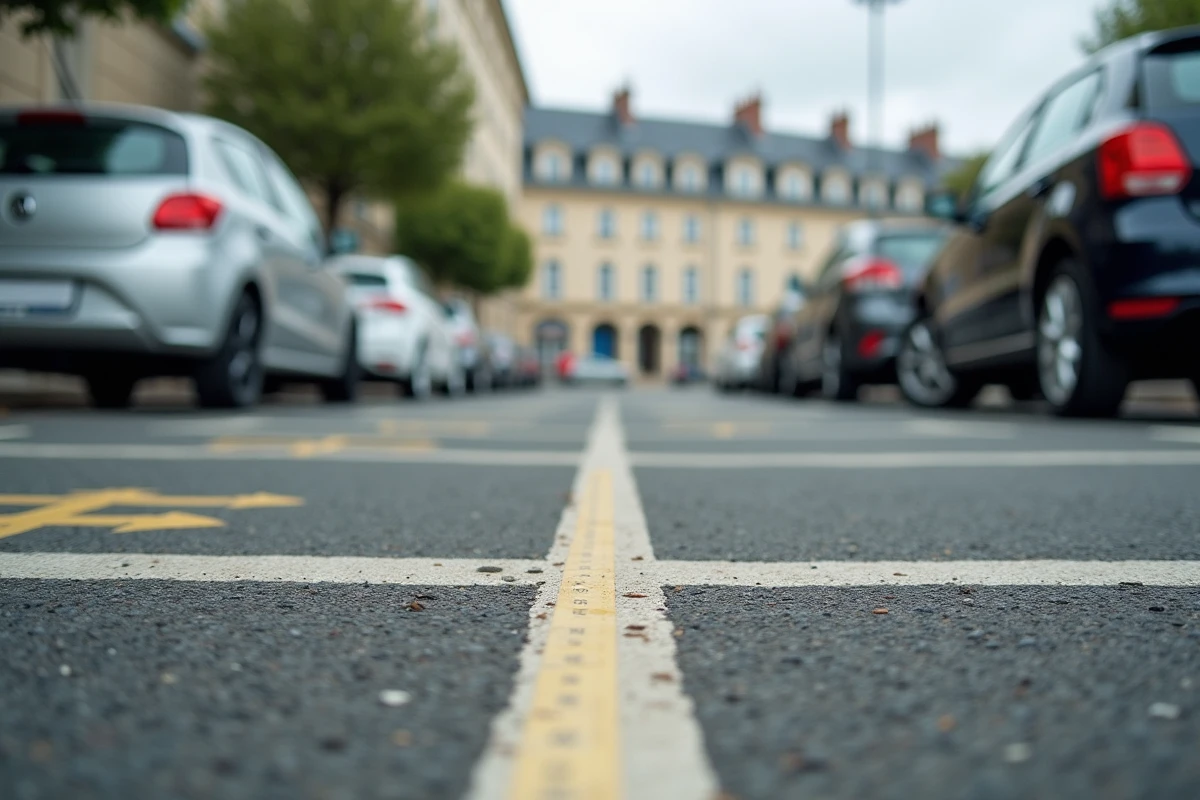
Parking spaces in France adhere to specific dimensional standards, but these standards vary depending on the type of parking, the presence of obstacles, and the target audience. Understanding these regulatory dimensions allows for an assessment of whether a location is truly suitable for a vehicle, or if a development project complies with current requirements.
Minimum width of 2.30 m: a standard already contested in the Senate
The most cited reference for structured parking is the decree of September 24, 2021, which sets the minimum width of a space at 2.30 m. This threshold presents a concrete problem: the average length of recent vehicles often exceeds 4.50 m, and their width has followed the same trend.
The written question No. 01891 from Mr. Jean-Louis Masson, published in the JO Senate on November 3, 2022, highlighted this gap between regulation and the reality of the automotive fleet. The government responded that no modifications were planned in the short term. The standard remains fixed, while the average size of cars continues to increase.
Several major cities have been experimenting since 2022 with “wide spaces” or “XXL spaces” with widths ranging from 2.70 m to 3.00 m, particularly in Lyon. These expansions are based on local parking management choices, without integration into a national standard. You can find the dimensions of parking spaces on Tout Immo for a summary of current standards.
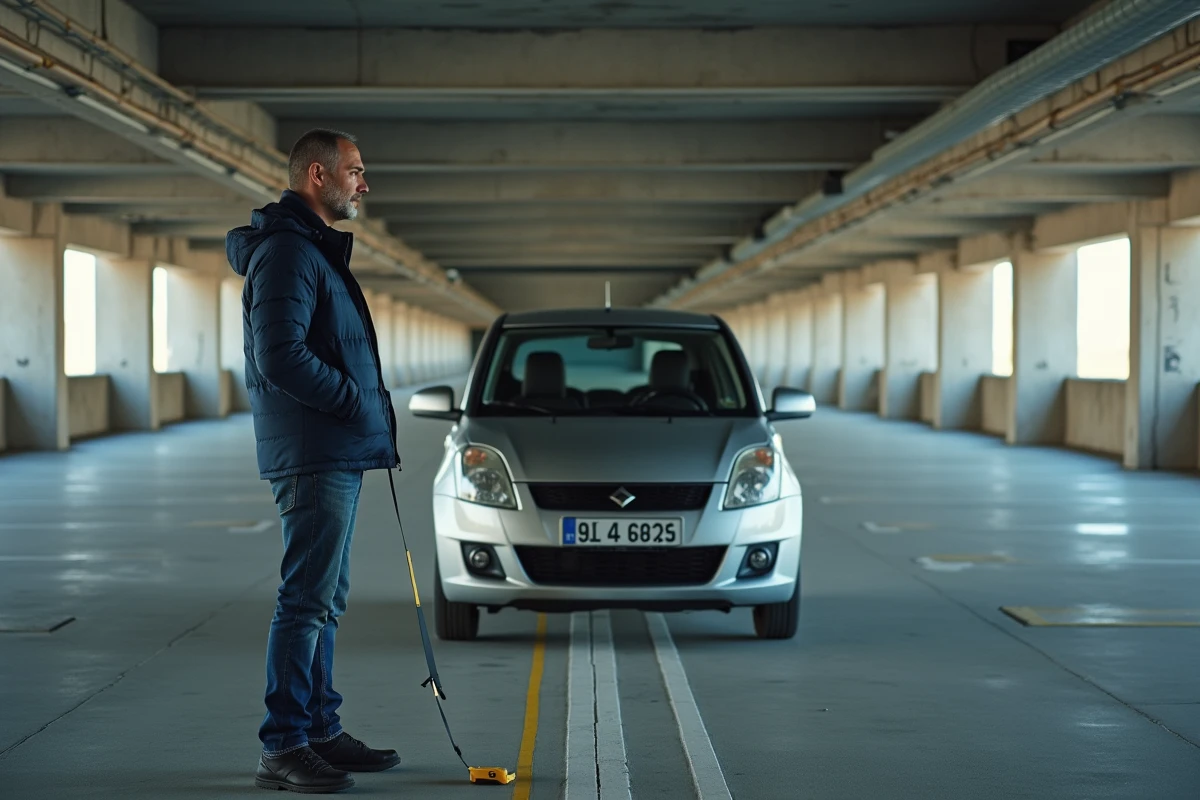
Dimensions of parking spaces according to the type of parking
Regulatory dimensions differ significantly depending on whether the parking is perpendicular, angled, or parallel. The table below summarizes the common values applied in public parking and new structures.
| Type of parking | Minimum width | Minimum length | Width of the circulation lane |
|---|---|---|---|
| Perpendicular (90°) | 2.30 m | 5.00 m | 5.00 m |
| Angled (45°) | 2.20 m | 5.00 m | 3.50 m |
| Angled (60°) | 2.25 m | 5.00 m | 4.00 m |
| Angled (75°) | 2.25 m | 5.00 m | 4.50 m |
| Parallel (longitudinal) | 2.00 m | 5.00 m minimum | Variable according to roadway |
Perpendicular parking at 90° requires the widest circulation lane, as entry and exit maneuvers necessitate a larger turning radius. In angled parking at 45°, the circulation lane narrows, allowing for more usable space in the parking lot.
Impact of an obstacle on the required width
When a wall, post, or pillar is adjacent to a space, the minimum width increases to compensate for the obstruction. A space bordered by an obstacle on one side generally requires extra width to allow for the proper opening of doors. Two obstacles on either side further exacerbate this constraint.
This point is often underestimated in older underground parking lots, where structural posts reduce the actual space well below comfortable usage.
Accessible parking spaces: dimensions significantly larger than standard spaces
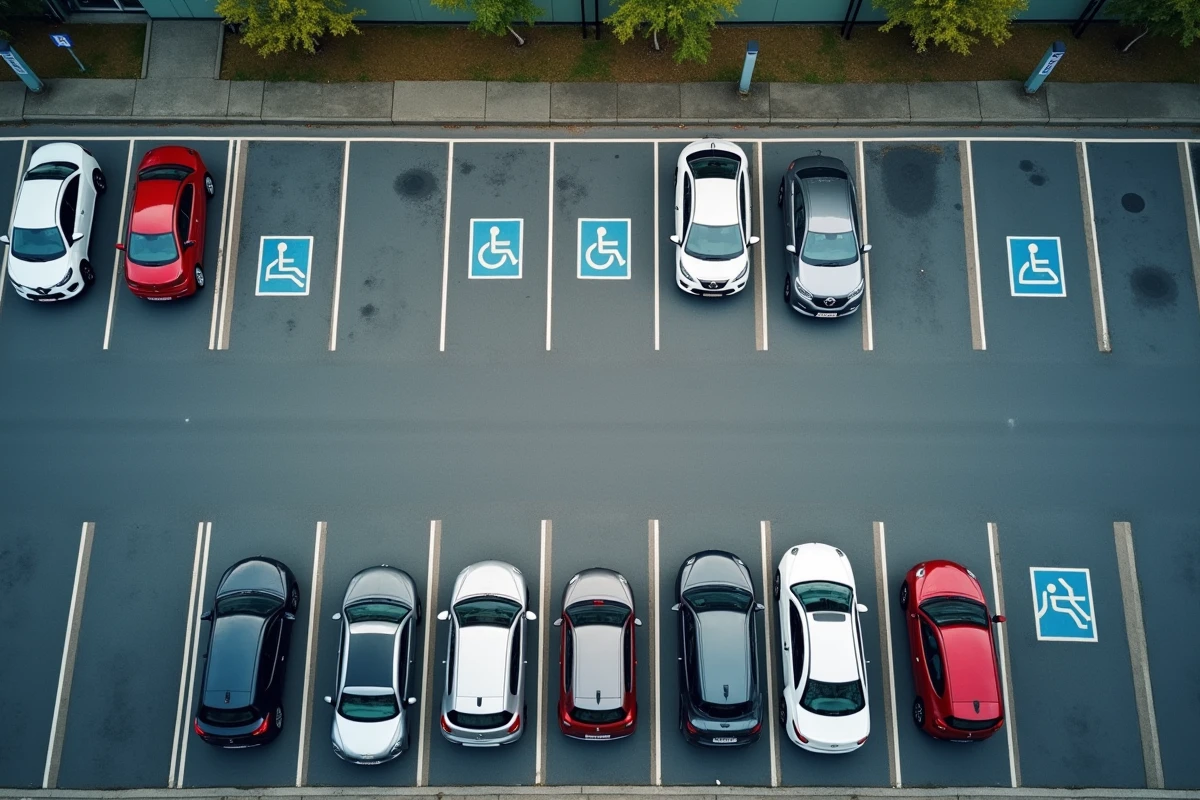
Spaces reserved for people with reduced mobility meet specific requirements, governed by regulations on accessibility for public establishments (ERP). Their sizing far exceeds that of standard spaces.
- Minimum width of 3.30 m, including a lateral transfer area of at least 0.80 m to allow for wheelchair passage
- Length identical to standard spaces (minimum 5.00 m), but with sufficient clearance behind the vehicle
- Mandatory ground marking with the disabled pictogram, supplemented by a vertical sign
- Location required to be as close as possible to the entrance of the building or elevator in a structured parking
Ground marking and vertical signage are not optional: their absence renders the space non-compliant, even if the dimensions are respected.
Electric charging stations and usable width of parking spaces
The Climate and Resilience Law of August 22, 2021, gradually mandates the installation of charging stations or electrical pre-equipment in new parking lots of ERP and collective housing. This obligation has a direct impact on the usable width of a space.
The conduits, bases for charging stations, and necessary protections reduce the available space on the driver’s or passenger’s side. In a parking lot dimensioned to the minimum regulatory width of 2.30 m, the addition of a charging station on one side can make the space difficult to navigate for a medium-sized vehicle.
Some developers anticipate this problem by planning wider pre-equipped spaces, but there is no national obligation setting a specific extra width for charging spaces. The gap between electrical equipment obligations and dimensional standards remains a blind spot in the regulations.
Ground marking and signage: what the standard actually imposes
The ground marking of a parking lot is not limited to the boundary lines of the spaces. Several signaling elements are governed by precise rules:
- Boundary lines must be continuous and in a color contrasting with the surface (white or yellow as applicable)
- Directional arrows in the circulation lanes indicate the direction of travel and are mandatory in multi-level structured parking
- Marking for accessible spaces includes the standardized pictogram painted on the ground, with a blue or white color depending on the type of parking
- No-parking zones (in front of emergency exits, fire access) must be identified by hatching
A lack of marking can lead to non-compliance of the parking lot during a safety commission inspection, with consequences for the operation of the structure.
French regulations on parking dimensions have not evolved at the pace of the automotive fleet. With standards frozen since 2021, ever-wider SUVs, and charging stations encroaching on space, the standard parking space of 2.30 m wide is becoming an increasingly tight format. Adjustments remain local and voluntary for now, with no national revision in sight.